

Overclocked · AI Fluency Classroom

Study

Why AI is outrunning us
Page 2 of 6 · Hubs 1–8

Welcome to Study, where we look at what is changing. AI is advancing exponentially while the institutions we live and work in adapt in steps, and this page is about that gap. Follow Aria through her first two scenes, read the article that unpacks the idea behind them, then open the hubs for a book, a short video and the latest news. Each one ends in a prompt for your own AI, and your best observation goes into your text file. Short on time? Every hub is numbered, so your organization can choose which ones to run.

Hub 1 · Story

The Problem

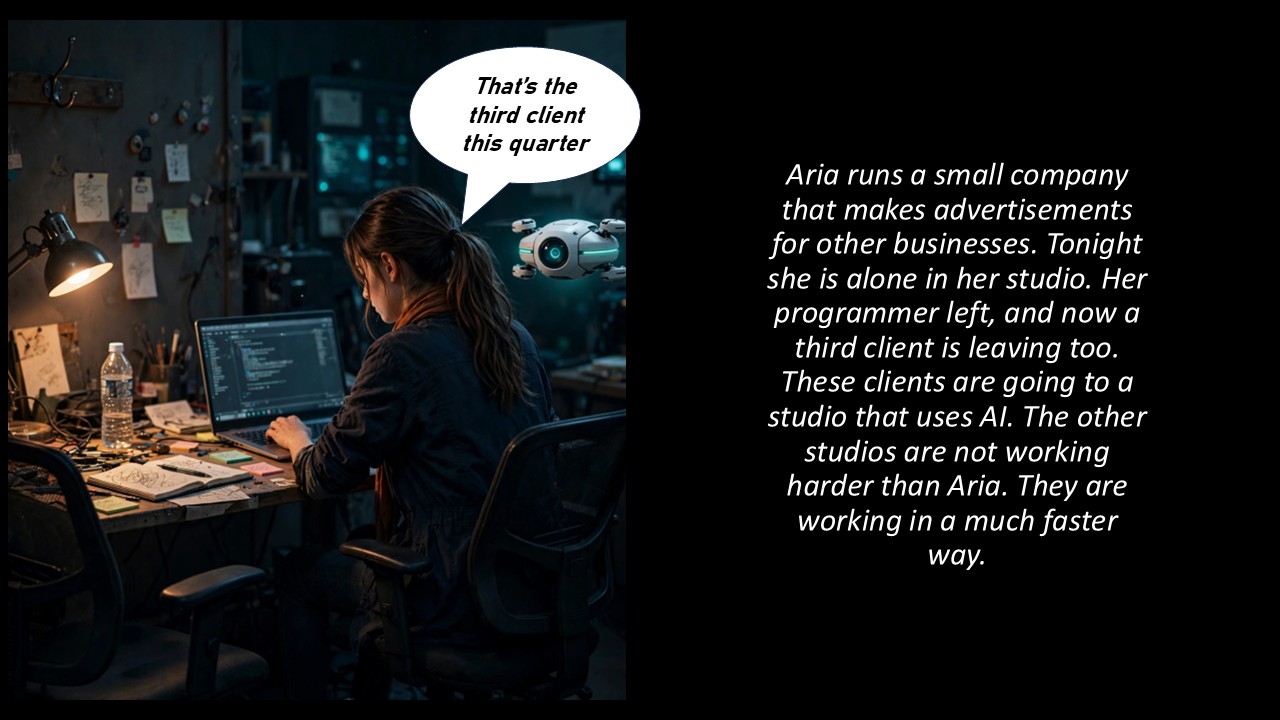
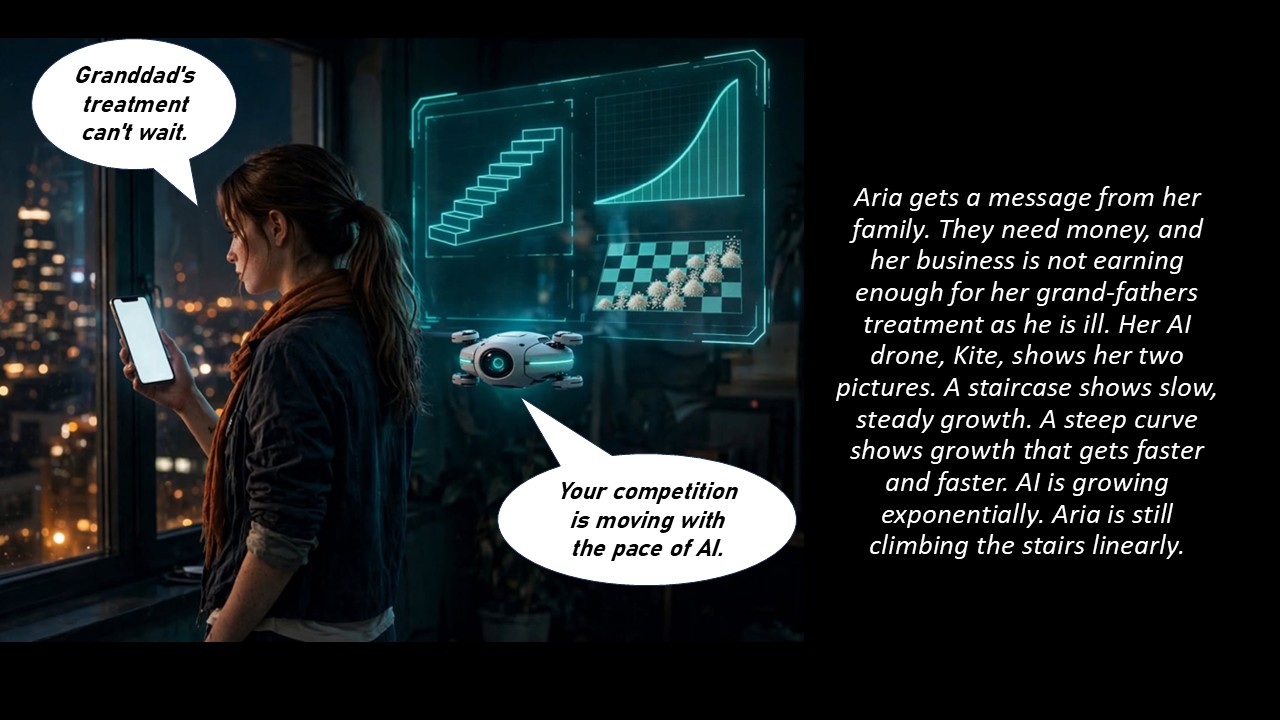
A third client has just left for a studio that works at the pace of AI. Kite shows Aria why: a steep curve rising beside the staircase she is still climbing.

Aria sits alone in her dark studio, facing a laptop, while Kite her drone hovers nearby assets/study/study-scene1-a.jpg
Aria looks at her phone by a window while Kite projects a holographic staircase and a steep exponential curve assets/study/study-scene1-b.jpg
Hub 2 · Story

The Research Begins

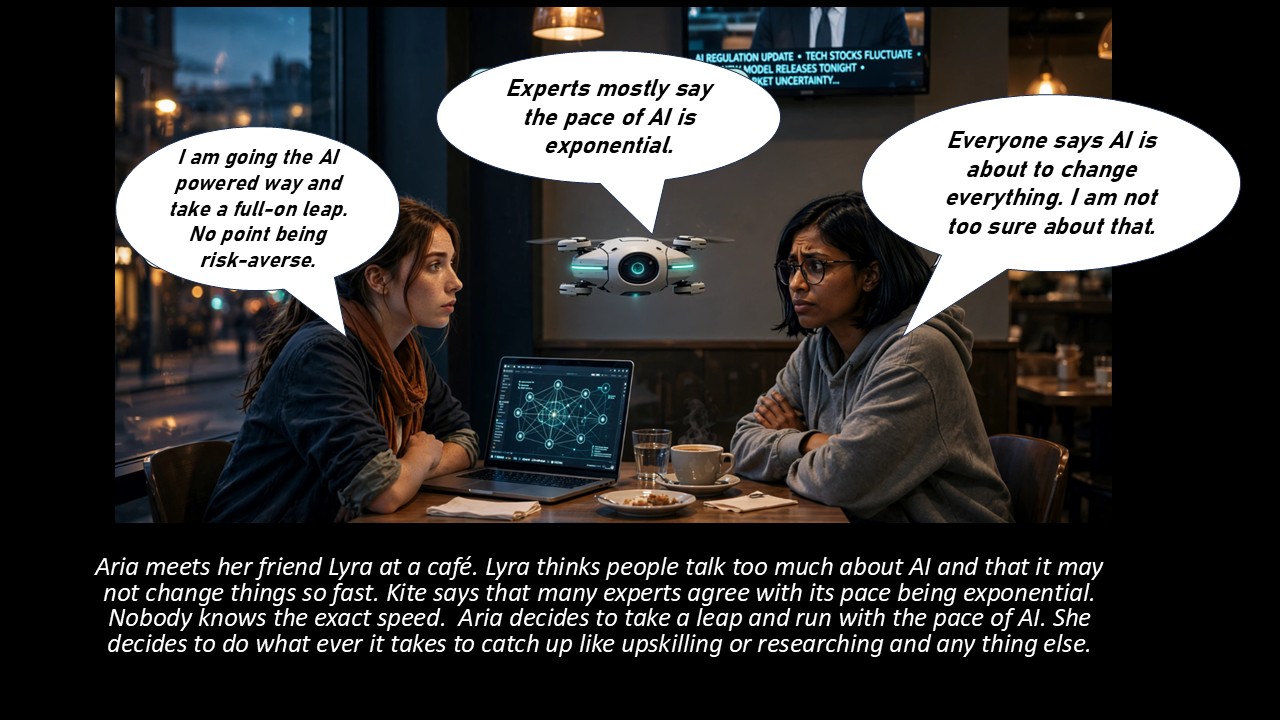
Kite finds Aria three books in the library, each one a signal of what is coming. Over coffee her friend Lyra doubts the hype, but Aria decides to leap anyway.

Aria stands in a library while Kite projects three glowing holographic books assets/study/study-scene2-a.jpg
Aria sits at a cafe table with her friend Lyra while Kite hovers between them assets/study/study-scene2-b.jpg
Hub 3Study Article · Understanding Exponentials
A glowing exponential curve rising steeply beside a slow stone staircase above a night city, in sci-fi comic style assets/study/study-article.jpg

The Exponential Gap

AI is improving in leaps. Our schools, companies and governments improve in steps. The space between the two is where the next decade will be decided.

Written with AI from the sources below. 4 min read

In the story, Kite showed Aria two pictures: a staircase and a steep curve. This article unpacks that idea.

Quick Read

AI abilities are growing in leaps while our institutions change in steps, and the gap between them is widening. One driver to watch is AI helping to build AI, though experts disagree on how fast that will happen. The practical response is not panic but practice: short, repeated experiments with the tools, tied to a real goal. Skip to the prompt ↓

Imagine a chessboard. Put one grain of rice on the first square, two on the second, four on the third, and keep doubling. The first few squares look like nothing. By the twentieth square you need more than half a million grains, and by the last one the pile is bigger than any farm could ever grow. That is exponential growth: something that multiplies instead of simply adding.

Now imagine a staircase, where every step is the same height as the one before. That is linear change: steady, and easy to plan for.

Here is the uncomfortable idea at the heart of this classroom. Many AI abilities have been improving in leaps, while the places where most of us work and learn change in steps. Courses are rewritten every few years. Budgets are set once a year. A hospital can take years to approve a new way of working, while a new AI feature can reach millions of people within weeks. None of this is a failing. Institutions are built to be steady, and steadiness is what lets us trust them. But when a fast curve runs beside a slow staircase, the space between them keeps growing.

The analyst Azeem Azhar gave this space a name in his book Exponential: the gap between how quickly technology moves and how quickly society can keep up with it. You can see it in small ways. A tool you learned in spring does something new by autumn. A rule your team wrote last year no longer fits what the software can do.

Why might the curve get even steeper? One reason is that AI is starting to help build AI. Researchers call this recursive self-improvement, which simply means a system that helps improve itself, so that each version helps make the next one better. Think of a student who helps write the next edition of the textbook they study from. Today's AI tools already help engineers write and check software, and AI developers have said they use such tools in their own work. In an essay titled "When AI builds itself," the Anthropic Institute treats this possibility as serious, something worth preparing for rather than ignoring.

When a fast curve runs beside a slow staircase, the space between them keeps growing.

Not everyone agrees on how fast this will happen. In August 2026, MIT Technology Review published a more cautious look at the idea, under a headline suggesting the self-improving loop might not arrive as quickly as some expect. It is a useful counterweight. A discovery in a laboratory still has to be tested, paid for, powered and trusted before it reaches a classroom or a clinic, and those steps take time.

So where does that leave a reader in the middle? The honest answer is that nobody knows the speed. A sensible plan works across a range. If the fast curve arrives later than predicted, you will have built useful skills early. If it arrives sooner, you will not be starting from zero.

Whether you are a student choosing a career, a manager planning next year's training, or a retired teacher curious about the tools your grandchildren use, the question is the same: how do I keep learning at a useful speed?

That is why the gap is better treated as a design problem than as a reason to worry. You cannot make a school or a company move at the speed of software, and you should not try to replace what already works. What you can do is add a fast layer beside the slow one: short cycles of learning and testing with the tools themselves, aimed at a real problem you care about, shared with a team that compares notes. Close the gap by practice, one small experiment at a time.

The prompt below is the start of that practice. Where in your own work is the staircase slowest, and what would change if the curve ran twice as fast?

Shaped by
  • Azeem Azhar, Exponential (book), on the gap between the pace of technological change and society's ability to keep up. Summary: Welcome to the Jungle
  • Anthropic Institute, "When AI builds itself," on recursive self-improvement: anthropic.com/institute
  • MIT Technology Review, 18 August 2026, a more cautious view of how soon recursive self-improvement may arrive: technologyreview.com
Further reading: IBM Think · Oman Observer opinion Written with AI from the sources above and independent research. Like a teacher sharing an article with a class, we credit the writers, but they did not write or review this piece. The Anthropic Institute is part of an AI developer, so it is paired here with an independent, more cautious source.
The Bridge

Take this article into your own work. Copy the prompt, paste it into your own AI, and share your Purpose Prompt when it asks. You will get three observations; pick one and save it to your text file.

// PROMPT COPIED — PASTE INTO YOUR AI //
Hub 4Library Hub
A quiet futuristic library archive with an android archivist among glowing shelves assets/study/study-library.jpg

Aria went to the library to collect clues. Now it is your turn.

In the story, Kite found three books for Aria, each one a signal about what is coming. Give your AI your Purpose Prompt and it suggests three real books tied to your solution design goal. Choose one and ask for a short abstract of its core ideas, then bring one insight back to your text file.

AI tools can sometimes get a title or author wrong. Check that a book exists before you buy or cite it.

// PROMPT COPIED — PASTE INTO YOUR AI //
Cover of The AGI Chronicles by Kevin Roose
Featured Book

The AGI Chronicles, by Kevin Roose

New this October from Farrar, Straus and Giroux and described in publisher listings as drawing on more than 150 interviews with insiders. A reported look at how the race to advanced AI has unfolded, and a good companion to the article above.

Book details
Hub 5Video Hub
A screening room where a holographic neural network floats above rows of seats assets/study/study-video.jpg

Aria upskilled by learning how neural networks work. Follow her lead.

Part of Aria's journey is understanding the technology that is outrunning her, so she researches how neural networks work. Here is a short video on exactly that: what a neural network actually is, in plain language, in about five minutes. Watch it below, then copy the prompt. Your AI asks for your Purpose Prompt and gives you three observations built on the video's core idea.

// PROMPT COPIED — PASTE INTO YOUR AI //
What Is a Neural Network? · Open on YouTube
Hub 6News Hub
A wall of scrolling holographic headlines and data streams in a futuristic city assets/study/study-news.jpg

Aria's research did not stop at books. She kept up with the latest AI trends.

To decide what to do next, Aria needed to know what is happening in AI right now. Your AI searches the web for the freshest news and discussion connected to your solution design goal, then gives you three observations on what it means for your direction.

This hub needs an AI that can search the web. If yours can't, it will ask you to paste a few headlines instead.

// PROMPT COPIED — PASTE INTO YOUR AI //
A rotating AI news portal: The Batch
Hub 7 · Optional
Running this classroom alongside a session you're already holding? Open here.

Share your Purpose Prompt, paste a summary of one or two paragraphs (a pre-talk abstract, or your own notes after the talk), and your AI returns three observations on what the session changes in your understanding of your solution design goal. Your organization posts the speaker summaries in the speaker-hub channel on Discord.

Facilitators: before teams open this hub, post the speaker's one-to-two-paragraph summary (a pre-talk abstract or post-talk notes) in the speaker-hub channel on Discord.

Paste only what your organization allows you to share with an AI tool.

// PROMPT COPIED — PASTE INTO YOUR AI //
Hub 8Collaboration Zone
People and friendly androids collaborating around tables in a bright high-tech hall assets/study/study-collaboration.jpg
Zone · Study report

Turn individual notes into one team report.

The team captain gathers every teammate's observation text file (by Discord, email, WhatsApp or similar), adds their own, and runs the prompt below. You get the Study report, about 500 words, that carries your shared understanding into Explore.

When the report is ready, share it with every teammate and save it.

// PROMPT COPIED — PASTE INTO YOUR AI //

CONTENTS

01Start 02Study 03Explore 04Ideate 05Develop 06Upskill