The Drummer Who Gained a Bandmate
A drummer who lost part of his arm got a prosthesis that reads his muscles and adds a second stick with ideas of its own. The lesson is about adding to a person, not replacing one.
A true story. Written with AI from the sources below. 4 min read
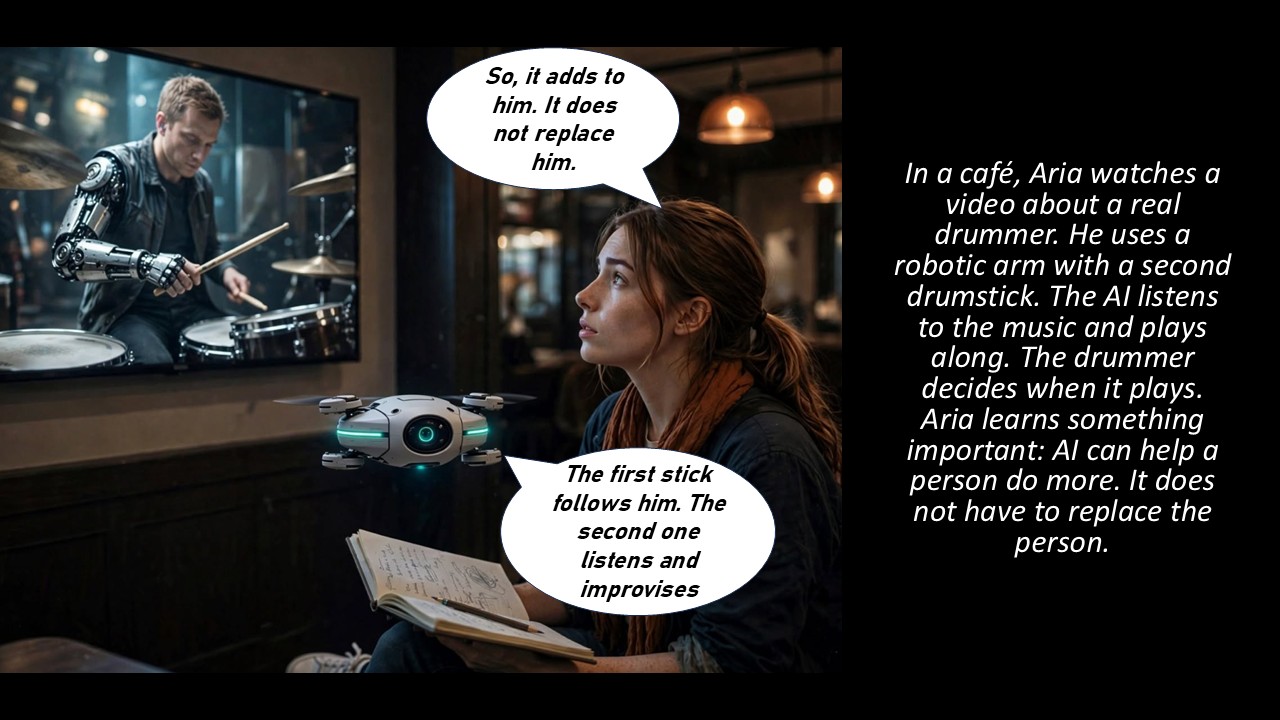
In the story, Aria watched a video of this drummer in a café and learned that AI can help a person do more. Here is his full story, starting with the same video.
Drummer Jason Barnes lost his right arm below the elbow, and a Georgia Tech team built him a robotic prosthesis. One stick follows his muscle signals. A second stick listens to the music and improvises on its own. He stays in charge and can pull it back whenever he wants. The idea to borrow: use AI to add capability to people, with people in control. Skip to the prompt ↓
Jason Barnes had wanted to be a professional drummer since he was a teenager. In 2012 an electrical accident took his right arm below the elbow. After a long stay in hospital and several operations, he set his mind on getting back to the drums.
He did not wait for someone to solve it for him. He built his own prosthesis, a spring-loaded drumstick, and carried on studying at a music school in Atlanta. It worked up to a point. He could play by moving his elbow, but without a wrist or fingers he could not control how fast the stick moved or how it bounced back off the drum. For a drummer, that bounce is everything.
His teacher introduced him to Gil Weinberg, a professor and the founding director of the Georgia Tech Center for Music Technology, who had already spent years building robots that play music. Weinberg's team made Barnes a robotic prosthesis with motors that power not one drumstick but two.
The first stick follows Barnes. Sensors read the signals from the muscles in his arm, so when he flexes, a computer tightens or loosens the stick and changes how it rebounds. In other words, the machine learns to listen to the person.
The person stays in charge. The AI adds something he did not have.
The second stick is where the story turns. It has its own small computer, which listens to the music being played, picks up the beat, tempo and how busy the playing is, and improvises a part that fits. Barnes does not control it directly. If he wants to play alone, he pulls it away from the drum. If he is curious, he lets it play and responds to what it does. Weinberg described it as having a mind of its own.
Notice what the team chose not to build. They did not build a robot to replace a drummer. In an interview with Vice, Weinberg said the aim was to learn more about how people create and improvise, not to take musicians' jobs. The machine does three things that are worth borrowing. It reads human intent from messy signals. It adds a partner that contributes something the person cannot. And it leaves the human with the final say.
The story also has an honest footnote about the distance between a lab and everyday life. MathWorks reported that the system was complex enough that each performance needed an elaborate set-up from the Georgia Tech team, and Weinberg hoped to redesign it so that Barnes could perform anywhere. The team has also worked on a shoulder-mounted extra arm controlled by brain signals, according to ASME. Good ideas often start out fragile and become practical in steps.
So here is the question to take away. Where, in your own solution, could AI listen to people and add a capability they do not have, while they stay in charge? The prompt below helps you find out.
Shaped by
- Georgia Tech News, "Robotic Prosthesis Turns Drummer into a Three-Armed Cyborg," the university's account of the device: news.gatech.edu
- IEEE Spectrum, "Cyborg Drumming Arm Makes Amputee Into Superhuman Musician," on how the two sticks work: spectrum.ieee.org
- ASME, "A Prosthetic Arm Bangs the Drums," on the later shoulder-mounted arm: asme.org
- MathWorks, headline story on how the team modelled the stroke and the set-up challenge: blogs.mathworks.com
- The video above, in which the drummer tells his story: youtube.com
Take this story into your own work. Copy the prompt, paste it into your own AI, and share your Purpose Prompt when it asks. You will get three observations; pick one and save it to your text file.