

 assets/study/study-article.jpg
The Exponential Gap
AI is improving in leaps. Our schools, companies and governments improve in steps. The space between the two is where the next decade will be decided.
Written with AI from the sources below. 4 min read
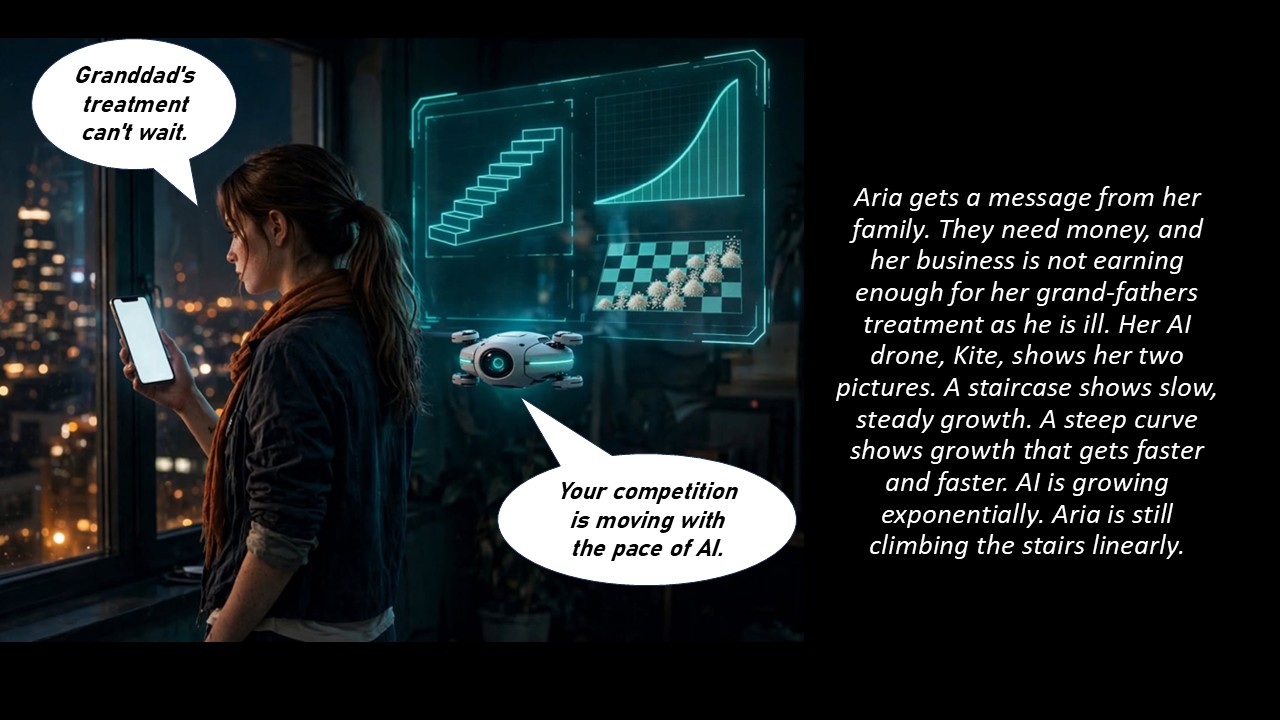
In the story, Kite showed Aria two pictures: a staircase and a steep curve. This article unpacks that idea.
AI abilities are growing in leaps while our institutions change in steps, and the gap between them is widening. One driver to watch is AI helping to build AI, though experts disagree on how fast that will happen. The practical response is not panic but practice: short, repeated experiments with the tools, tied to a real goal. Skip to the prompt ↓
Imagine a chessboard. Put one grain of rice on the first square, two on the second, four on the third, and keep doubling. The first few squares look like nothing. By the twentieth square you need more than half a million grains, and by the last one the pile is bigger than any farm could ever grow. That is exponential growth: something that multiplies instead of simply adding.
Now imagine a staircase, where every step is the same height as the one before. That is linear change: steady, and easy to plan for.
Here is the uncomfortable idea at the heart of this classroom. Many AI abilities have been improving in leaps, while the places where most of us work and learn change in steps. Courses are rewritten every few years. Budgets are set once a year. A hospital can take years to approve a new way of working, while a new AI feature can reach millions of people within weeks. None of this is a failing. Institutions are built to be steady, and steadiness is what lets us trust them. But when a fast curve runs beside a slow staircase, the space between them keeps growing.
The analyst Azeem Azhar gave this space a name in his book Exponential: the gap between how quickly technology moves and how quickly society can keep up with it. You can see it in small ways. A tool you learned in spring does something new by autumn. A rule your team wrote last year no longer fits what the software can do.
Why might the curve get even steeper? One reason is that AI is starting to help build AI. Researchers call this recursive self-improvement, which simply means a system that helps improve itself, so that each version helps make the next one better. Think of a student who helps write the next edition of the textbook they study from. Today's AI tools already help engineers write and check software, and AI developers have said they use such tools in their own work. In an essay titled "When AI builds itself," the Anthropic Institute treats this possibility as serious, something worth preparing for rather than ignoring.
When a fast curve runs beside a slow staircase, the space between them keeps growing.
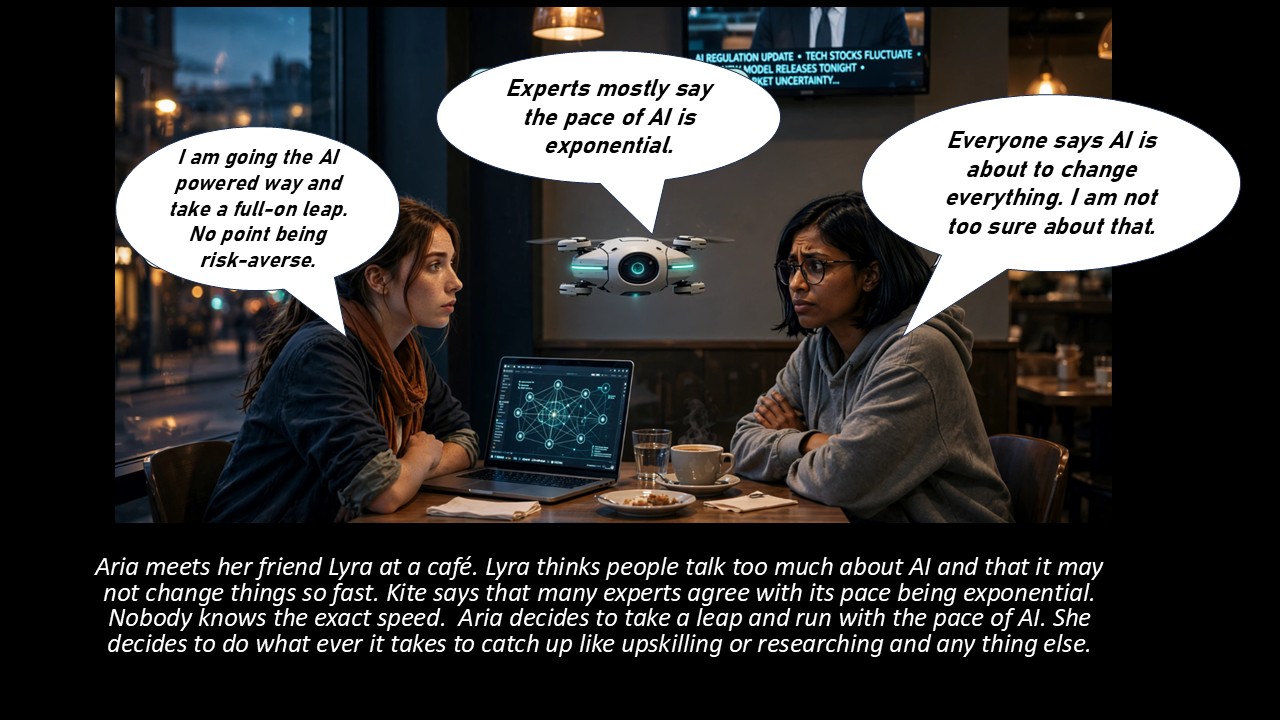
Not everyone agrees on how fast this will happen. In August 2026, MIT Technology Review published a more cautious look at the idea, under a headline suggesting the self-improving loop might not arrive as quickly as some expect. It is a useful counterweight. A discovery in a laboratory still has to be tested, paid for, powered and trusted before it reaches a classroom or a clinic, and those steps take time.
So where does that leave a reader in the middle? The honest answer is that nobody knows the speed. A sensible plan works across a range. If the fast curve arrives later than predicted, you will have built useful skills early. If it arrives sooner, you will not be starting from zero.
Whether you are a student choosing a career, a manager planning next year's training, or a retired teacher curious about the tools your grandchildren use, the question is the same: how do I keep learning at a useful speed?
That is why the gap is better treated as a design problem than as a reason to worry. You cannot make a school or a company move at the speed of software, and you should not try to replace what already works. What you can do is add a fast layer beside the slow one: short cycles of learning and testing with the tools themselves, aimed at a real problem you care about, shared with a team that compares notes. Close the gap by practice, one small experiment at a time.
The prompt below is the start of that practice. Where in your own work is the staircase slowest, and what would change if the curve ran twice as fast?
Shaped by
- Azeem Azhar, Exponential (book), on the gap between the pace of technological change and society's ability to keep up. Summary: Welcome to the Jungle
- Anthropic Institute, "When AI builds itself," on recursive self-improvement: anthropic.com/institute
- MIT Technology Review, 18 August 2026, a more cautious view of how soon recursive self-improvement may arrive: technologyreview.com
Take this article into your own work. Copy the prompt, paste it into your own AI, and share your Purpose Prompt when it asks. You will get three observations; pick one and save it to your text file.