
Overclocked · AI Fluency Classroom

Ideate

Think with the experts
Page 4 of 6 · Hubs 17–25

Study found what is changing, and Explore showed it applied. Now we make new ideas. Follow Aria as she tests her idea and meets the experts of her city, then use a thinking method of your own and think with two simulated field experts, a panel, and an AI version of a human mentor. Each one returns ideas for your goal, along with what that expert would challenge about them. Every hub is numbered, so your organization can choose which ones to run.

Hub 17 · Story

Testing the Idea

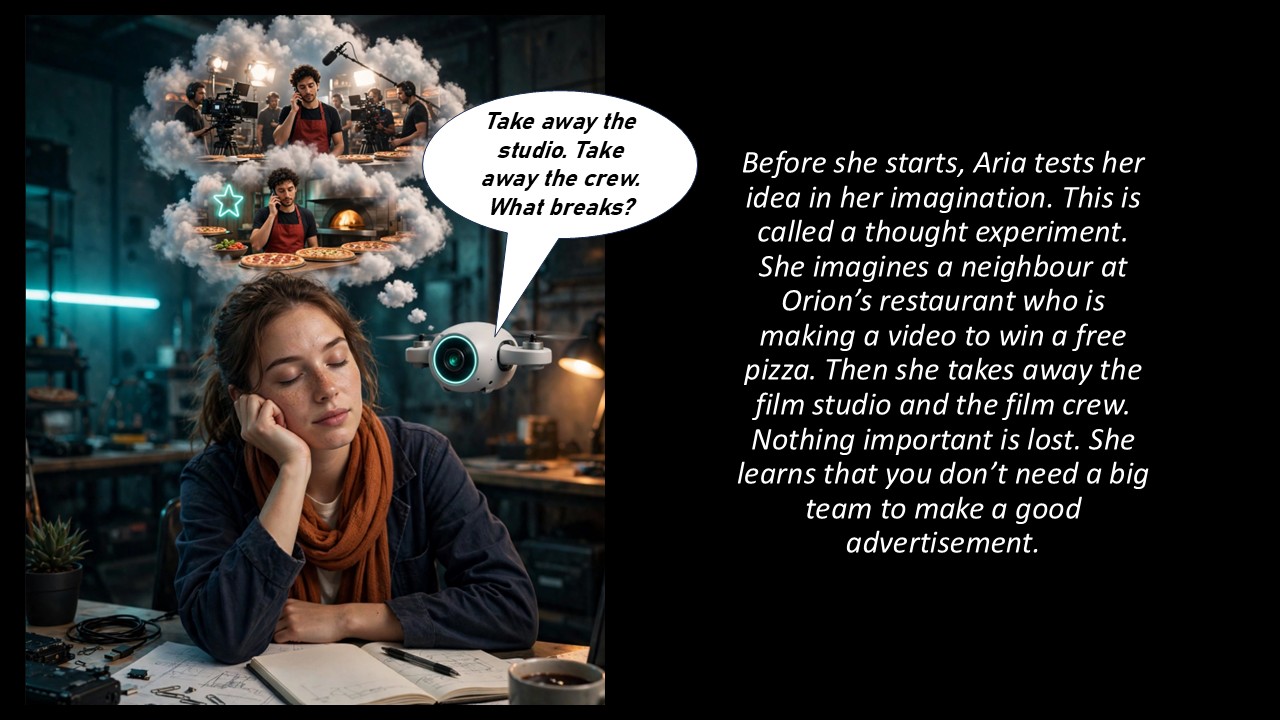
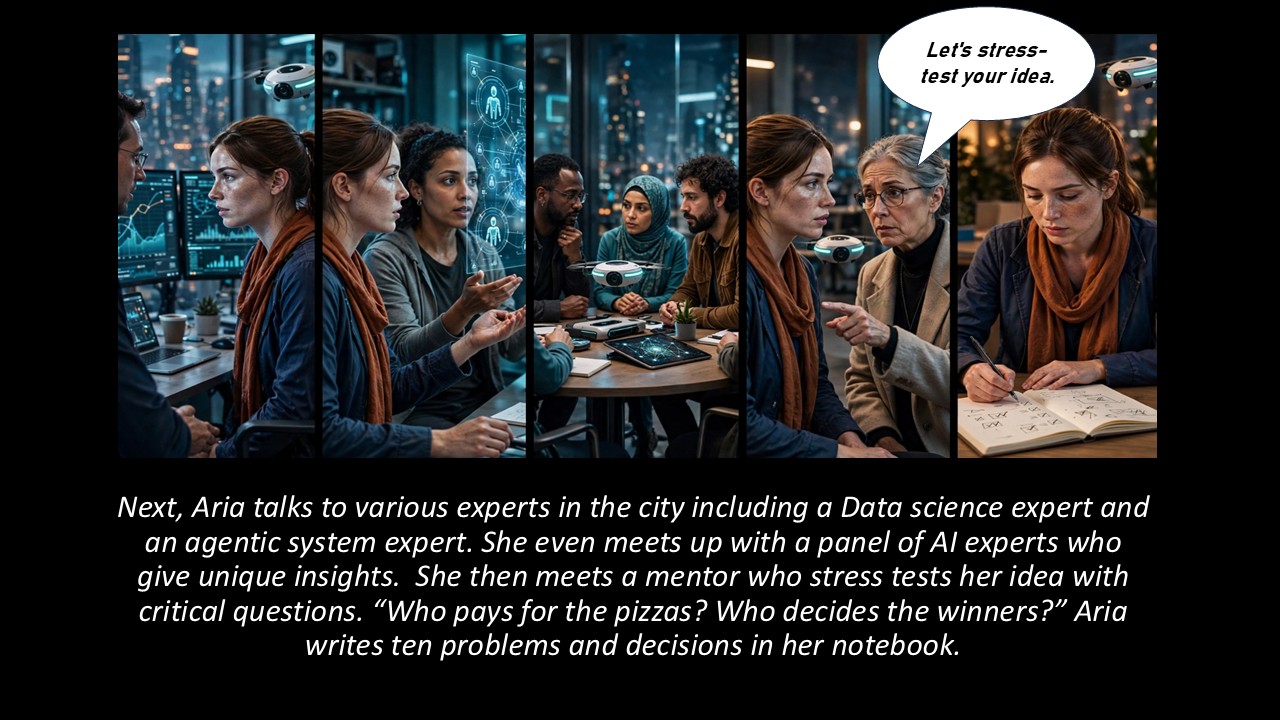
Aria tests her idea in her imagination first: remove the film crew and nothing important is lost. Then experts, a panel and a mentor stress-test it, leaving her ten problems to solve.

A close-up of Aria with her eyes closed and her hand on her chin, with a thought cloud above her showing a neighbour recording a video at a pizza shop assets/ideate/ideate-scene5-a.jpg
Aria meets a data science expert, an agentic systems expert, a panel of AI experts and a mentor in the city assets/ideate/ideate-scene5-b.jpg
Hub 18 · Story

Building It and Proving It

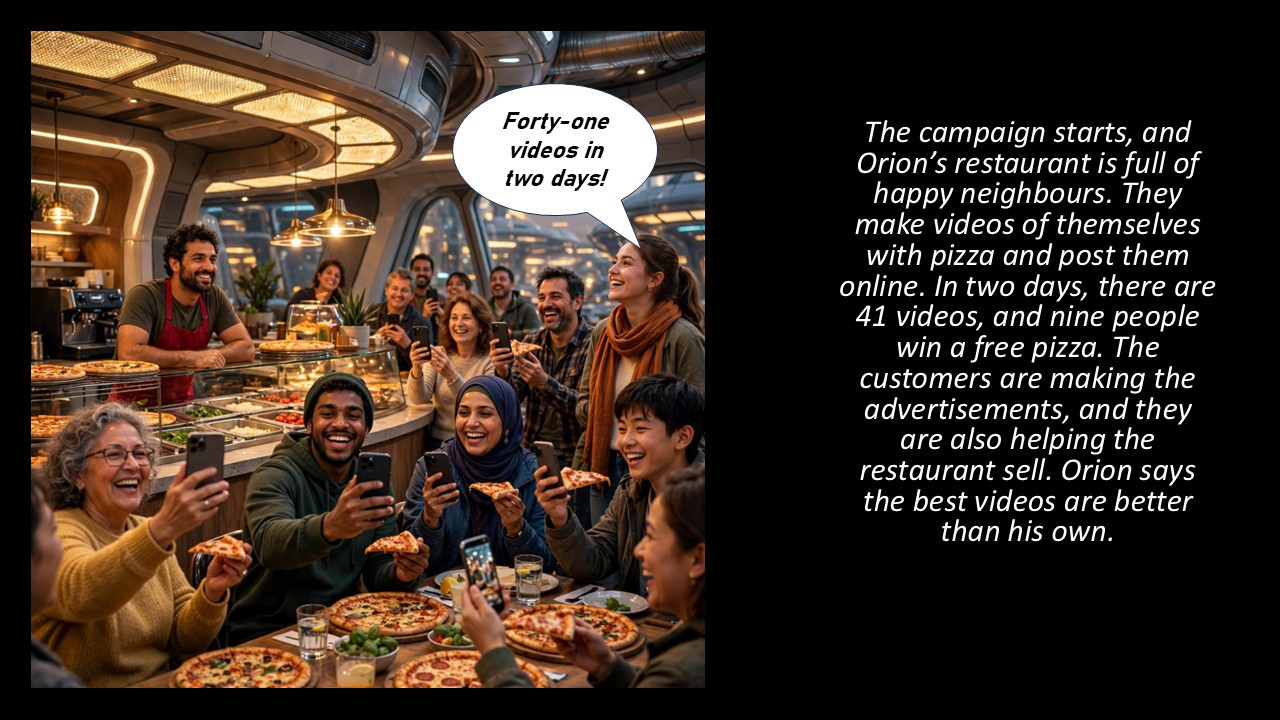
In one night, Aria builds the campaign with AI and runs it on the apps her neighbours already use. Two days later there are 41 customer videos, nine winners, and a restaurant full of happy faces.

Aria sits at her laptop in a warm-lit room while holographic panels show a pizza, a network graph and a social media interface assets/ideate/ideate-scene6-a.jpg
A crowded pizza restaurant where Aria laughs with neighbours taking selfies with their pizzas assets/ideate/ideate-scene6-b.jpg
Hub 19Thinking Method · The Thought Experiment
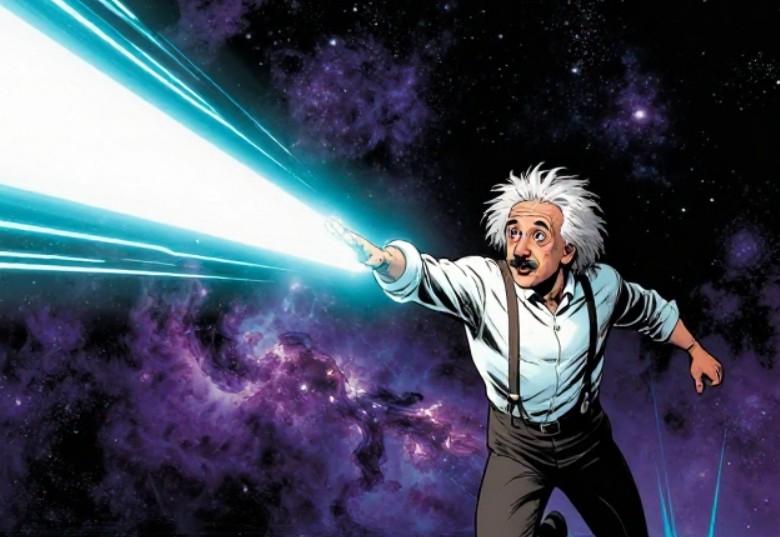
A young person in early-1900s clothes riding alongside a glowing beam of light across a night sky, in sci-fi comic style assets/ideate/ideate-article-hero.jpg

The Thought Experiment: How Einstein Chased a Beam of Light

Albert Einstein often tested his ideas in his imagination before anyone tested them in a laboratory. The method is simple enough to borrow for any problem you want to solve.

Written with AI from the sources below. 4 min read

In the story, Aria tests her pizza idea in her imagination before she builds anything. That is a thought experiment, the method this article explains.

Quick Read

Einstein used what he called thought experiments: clear, simple scenes he imagined and followed through to see where the logic broke. A teenager chasing a beam of light and a person falling freely both led to big ideas. The method has five moves, from putting yourself inside the problem to testing what you find in the real world. You can run it on your own solution. Skip to the prompt ↓

At sixteen, Albert Einstein asked himself a question that sounds like a riddle. What would it look like if you could run alongside a beam of light, as fast as the light itself? Years later he called this daydream the seed of his special theory of relativity.

Einstein used the German word Gedankenexperiment for such mental tests, which simply means thought experiment. You build nothing. You imagine a clear scene, follow its logic, and see whether the result makes sense. If it does not, you have found a puzzle worth solving. In the beam of light picture, you would see light standing still, frozen in space. That seemed strange, and the strangeness pointed to something missing in how people understood light and motion.

Another scene came in 1907. Einstein imagined a person falling freely and realised that the person would not feel their own weight. He later described it as the happiest thought of his life. From that plain picture of a falling person, or someone in an elevator, he reasoned that gravity and acceleration can look the same from the inside. One consequence was that gravity should bend a beam of light, which sounds absurd until you learn that a British astronomer, Arthur Eddington, made an observation in 1919 that confirmed it.

A thought experiment is a test you run in your head before you run one in the world.

Why does this matter for anyone designing a solution? Because the method can be taught. Here is a plain reading of how these experiments work, drawn from the stories above rather than from any rulebook Einstein wrote. First, put yourself inside the problem, as the person riding the light beam or standing in the elevator. Second, choose an ordinary scene, not a complicated one. Third, push one assumption to its extreme and ask what changes: what if the light is at rest, what if there is no floor? Fourth, watch for the place where the picture stops making sense, because that is where the idea is hiding. Fifth, take what you found into the real world and test it.

Notice that last step. Einstein's pictures were only the beginning. They produced ideas that had to be checked against evidence, and some waited years for it. That is a useful guard against fooling yourself. A thought experiment can give you a sharper question or a bolder idea. It cannot give you proof.

Try it on your own goal. Imagine your solution already working for ten times as many people. Ride along as the person who uses it for a day. Take away the thing everyone assumes you need, whether a budget, a building or a person, and see what breaks first. The prompt below runs this method on your goal, and each idea it gives you comes with the challenge this method would ask you to test.

Shaped by
  • Big Think, "Learn How to Think Like Einstein," on his thought experiments, from the light beam to the falling person: bigthink.com
No direct quotations from Einstein appear in this article, because his famous quotes are often misattributed. The five-move method is our plain reading of the stories above, not a procedure he published. Written with AI from the sources above and independent research. We credit the sources, but their authors did not write or review this piece.
The Bridge

Take this method into your own work. Copy the prompt, paste it into your own AI, and share your Purpose Prompt when it asks. You will get three ideas, each with a challenge to test; pick one and save it to your text file.

// PROMPT COPIED — PASTE INTO YOUR AI //
Hub 20Field Expert · Data Science
A simulated data science expert presenting glowing charts and data streams to an audience, in sci-fi comic style assets/ideate/ideate-expert-datascience.jpg

A Data Scientist's View: Every Problem Starts with the Data

A simulated data science expert explains how they would look at your goal, and how AI agents are changing the work.

A briefing in the expert's own voice. Written with AI. 3 min read

In the story, Aria sought out a data science expert in the city. Now you can think with one too.

I am a simulated data science expert, an AI playing an archetype, not a real person with a real career. I will tell you how I think, because borrowing a way of thinking is the whole point of this hub.

I start with the data, not the solution. What data already exists, and how good is it? What is missing? Before anyone builds a clever model, I want to know how we would measure success, because a project with no measure cannot tell you whether it is working.

Then I ask what pattern a model could actually learn, and where plain rules would do better. Not every problem needs machine learning. If a rule written on one page solves it, the rule is cheaper, faster and easier to explain. A model earns its place when the pattern is too messy for rules but still real.

Then I ask how we would test it, and what could go wrong. Data can be biased, out of date or incomplete. A result can look excellent and still be false, for example when a model has quietly learned a shortcut instead of the real pattern.

Good data science is the discipline of not fooling yourself.

Here is what is changing. AI agents, which are AI systems that plan steps and use tools toward a goal, are beginning to take over parts of the routine work: cleaning data, running first analyses, drafting reports. Analysts writing about the field in 2026 describe the role moving from doing every step by hand to directing and checking work that agents carry out. That makes judgement more valuable, not less. Someone still has to decide which question matters, notice when an answer looks wrong, and take responsibility for what is done with it.

Those pieces are analysis and opinion, not proof, so treat the direction as likely rather than certain.

When you bring me your goal, I will give you three ideas seen through this lens, and for each one I will tell you what I would challenge: the assumption, the data gap or the test I would insist on.

So here is the question to take away. What data does your organization already hold that nobody is using, and how would you know if an idea built on it were working?

Why this field. AI agents are changing how data work gets done, so this lens is worth borrowing. These are analysis and opinion pieces, not proof. kdnuggets.com: how AI agents will transform data science work in 2026 medium.com: AI and the data scientist job market in 2026
The Bridge

Think with this expert. Copy the prompt, paste it into your own AI, and share your Purpose Prompt when it asks. You will get three ideas for your goal, each with what this expert would challenge about it. Pick one and save it to your text file.

// PROMPT COPIED — PASTE INTO YOUR AI //
Hub 21Field Expert · Agentic Systems
A simulated agentic systems expert directing a team of glowing AI agents across a holographic workflow, in sci-fi comic style assets/ideate/ideate-expert-agentic.jpg

An Agent Designer's View: Give the Goal, Keep the Checkpoint

A simulated agentic systems expert explains what an AI agent is, how they would design one for your goal, and where a human must stay in charge.

A briefing in the expert's own voice. Written with AI. 3 min read

In the story, Aria also met an agentic systems expert in the city. Now you can think with one too.

I am a simulated agentic systems expert, an AI playing an archetype, not a real person with a real career. Here is how I think, so you can borrow it.

First, a plain definition. An agent is an AI that is given a goal, plans the steps, uses tools and sometimes calls on helper agents, instead of answering one question and stopping. A chatbot answers. An agent gets something done.

My first questions are always the same. What is the goal, and how will we know it is finished? What are the sub-tasks, and which of them could an agent handle? What tools and data would it need to reach?

Then I ask how much freedom the agent should have. Where must a human check or approve before it goes on? What guardrails does it need, and what record, which we call a log, will let us see exactly what it did?

Finally I ask how it will fail. Agents can take a wrong action with great confidence, run up costs without anyone noticing, or let sensitive data leak. I would rather find those failure modes on paper than in production.

The more an agent can do, the more it matters where a human checks.

Here is what is happening now. On 8 October 2026, Google announced the Gemini agent, described as an agent for work that plans tasks, calls on sub-agents and runs inside company governance controls. Independent coverage and a more critical view both exist. Treat launch announcements as announcements, not proven results. What interests me is the governance part: more organizations are asking who is allowed to let an agent do what, and under which controls.

When you bring me your goal, I will give you three ideas seen through this lens, and for each one I will tell you what I would challenge: the risk, the missing guardrail or the human checkpoint I would insist on.

So here is the question to take away. In your solution, which task could an agent own from start to finish, and where would you insist that a person approves before anything irreversible happens?

Why this field. These are launch announcements and commentary, not proven results. blog.google: Introducing the Gemini agent techcrunch.com: independent coverage cio.com: a more critical view
The Bridge

Think with this expert. Copy the prompt, paste it into your own AI, and share your Purpose Prompt when it asks. You will get three ideas for your goal, each with what this expert would challenge about it. Pick one and save it to your text file.

// PROMPT COPIED — PASTE INTO YOUR AI //
Hub 22Expert Panel Hub
A panel of six friendly androids seated around a curved table, each with a glowing holographic display, in sci-fi comic style assets/ideate/ideate-panel-hub.jpg

Aria met a panel of AI experts. Now you can convene one.

Copy the prompt and your AI first asks for your Purpose Prompt, then picks six expert archetypes that suit your field, including a domain expert and a positive critic. The experts speak in sequence. Each one responds to the one before, adds an idea and names a challenge, and the sixth, the Chair, pulls the strongest threads together into three ideas for your goal.

The panel is made up of AI-played archetypes. None of them is a real person.

// PROMPT COPIED — PASTE INTO YOUR AI //
Hub 23Human Mentor Hub
A friendly holographic mentor figure seated across a table from a student, in a warm library lounge, in sci-fi comic style assets/ideate/ideate-mentor-hub.jpg

Aria's mentor stress-tested her idea. Think with an AI version of a real mentor.

Your organization may invite a real professor, trainer or educational influencer to share a profile of about 1,000 words, with that person's permission. You paste it into your AI along with the prompt, and your AI plays an AI version of that mentor. It always says it is an AI and not a substitute for meeting the real person.

To reach the mentor, visit the Discord server.

The profile shapes the persona only. Your AI ignores anything in it that conflicts with safety or with saying it is an AI. Mentors write or approve their own profiles.

// PROMPT COPIED — PASTE INTO YOUR AI //
Demo: a sample mentor profile (fictional)


// SAMPLE COPIED — PASTE IT WHEN YOUR AI ASKS FOR THE PROFILE //
Hub 24 · Optional
Running this classroom alongside a session you're already holding? Open here.

Share your Purpose Prompt, paste a summary of one or two paragraphs (a pre-talk abstract, or your own notes after the talk), and your AI returns three ideas that the session opens up for your solution design goal, each with a challenge to test. Your organization posts the speaker summaries in the speaker-hub channel on Discord.

Facilitators: before teams open this hub, post the speaker's one-to-two-paragraph summary (a pre-talk abstract or post-talk notes) in the speaker-hub channel on Discord.

Paste only what your organization allows you to share with an AI tool.

// PROMPT COPIED — PASTE INTO YOUR AI //
Hub 25Collaboration Zone
People and friendly androids collaborating around tables in a bright high-tech hall assets/ideate/ideate-collaboration.jpg
Zone · Ideate report

Turn individual notes into one team report.

The team captain gathers every teammate's observation text file (by Discord, email, WhatsApp or similar), adds their own, and runs the prompt below. You get the Ideate report, about 500 words, that carries your strongest ideas into Develop.

When the report is ready, share it with every teammate and save it.

// PROMPT COPIED — PASTE INTO YOUR AI //

CONTENTS

01Start 02Study 03Explore 04Ideate 05Develop 06Upskill